Herman Miller: Where Green Manufacturing is Company Tradition.

Herman Miller walks the talk where the green office is concerned.

By 2020, the company plans to minimize solid, air, and water emissions; establish a LEED silver certification for its buildings; use 100% green energy; and sell 100% DfE-approved products.

This builds on a proud Herman Miller company tradition of sustainable design and construction – its headquarters was recognized as one of the first “green” office and manufacturing complexes in the U.S., with corresponding high numbers in employee productivity.

So we’re only following in the revered Herman Miller way when we at Cubicles.com offer remanufactured Herman Miller cubicles in our product lineup.

Our remanufactured cubicles look brand-new, but have been painstakingly reconstructed from pre-used Herman Miller cubes; they’re engineered to look, feel, and work like the brand-new product!

Just look at the extremes we reach to ensure that our cubicles are made with as little impact to the environment as possible:
(read more)

Rethinking Office Cubicles?

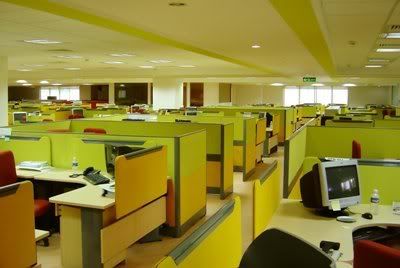
Image of cubicles © Arjun Kartha.

Office cubicles just work for many companies. They’re compact, efficient working spaces. They rationalize the use of office space. Finally, office cubicles offer an egalitarian solution that many highly-stratified companies turn to when communication breaks down between layers in the corporate hierarchy.

But has the time come to reconsider cubicles?

Consider this: layoffs are decimating the workforce – gaps in the cubicle village are starting to show. The space-saving cubicle is becoming obsolete in offices with office space to spare.

At the same time, a growing chunk of the remaining workforce has a different view of cubicle hierarchy: the enclosed walls clash with a millennial generation that values face time.

“Office design is going from an ‘I’ to ‘we’ concept,” says designer Collin Burry of Gensler, the global architectural and design firm. “Millennials would be miserable sitting in a closed office all day long.”

Companies now face the challenge of integrating the differing workspace demands of multiple generations within the same office. Case in point, healthcare concern McKesson and their redesigned office space:

read more

New Generation Office Chair Flexes its Muscle.

Office chairs have been around for as long as there’ve been offices. Is there anything new under the green fluorescent office glow?

Knoll’s new Generation office chair could be it: the ideal synthesis of materials and design, coming together to bring near-complete freedom of movement to the worker lucky enough to rest his bottom on one.

The Generation’s top 10 inches flex with your back to a near-extreme 90-degree recline. The seat pad can slide forward to reach just the right point behind the knee.

Elastomer upholstery (an open-weave backrest made from a rubber/plastic mix) and a close application of holistic ergonomics has created a chair with enough flexibility to adapt to a wide range of seating postures.

Lean back to watch the fluorescent lights throb, and the chair will bend to your will. Sit straight up, and the chair offers ideal lumbar support.

Knoll partnered with Formway Design to produce the Generation chair. The seat retails for $995 (the armless version) to $1,860 for higher-end models in assorted finishes.

Fastcompany.com reviewed three office chairs – including the Generation chair, which more than held its own against two other office seating stalwarts. Watch the video below, and when you’re done, find out more about the Generation chair by Knoll by reading this article: Generation Chair.


Ikea Rescues New York’s Thinnest Townhouse.

How in the world do you furnish New York’s slimmest townhouse?

This $2.7 million property in the heart of Greenwich Village is centrally located and has been home to some of New York’s foremost personalities, among them Cary Grant and John Barrymore.

The size limitations are quite daunting – 9.5 feet by 42 feet. Sorry, baby grand. Goodbye, king-size bed. And I guess your dreams of having a penthouse-level ballroom will have to go.

But the owner, Stephen Balsamo, seems to have made the most out of the townhouse’s slim margin of space. The New York Post reports

In the kitchen, a custom stove has all four burners in a single row, rather than the usual two-by-two arrangement. The three floors are all open, but the balconies overlooking the garden were extended, adding depth to make up for lack of width. [..]

Visitors to the home expect to find it dark and claustrophobic, but as a result of the sweeping windows in the back, “every floor has amazing light,” Nicholas said.

But who’s got furniture that can fit in these tight situations? Enter Swedish manufacturer (and furnisher of divorced men’s apartments) IKEA – whoever snaps up this Greenwich Village steal will also score free design advice and $10,000 in IKEA furniture.

Janice Simonsen, IKEA design expert and spokesperson, says “We’re so in love with small spaces that we’re putting an offer on the table… albeit a skinny table.”

Obama, the Green President.

The President of the United States is serious when he says the environment is a top priority of his administration. This week, the President’s walking-the-talk on green issues comes through General Motors, and interestingly enough, the White House.

At a GM plant in Ohio, President Obama hailed the new fuel economy standards that would decrease greenhouse gases and provide clear directions for auto designers.

“For too long,” the president told the autoworkers, “our auto companies faced uncertain and conflicting fuel economy standards. That made it difficult for you to plan down the road. That’s why, today, we are launching—for the first time in history—a new national standard aimed at both increasing gas mileage and decreasing greenhouse gas pollution for all new cars and trucks sold in America. This action will give our auto companies some long-overdue clarity, stability, and predictability.”

(read more)

This Week in Weird Cubicle Design…

Jurgen Bey believes that the cubicle concept shouldn’t be limited to the four walls of one’s office. Set the cubicle free!

Bey’s “Slow Car” concept takes an ordinary office cubicle and puts it on wheels. The concept gives a new twist to the phrase “cubicle jockeys”; one can sit down to work on the road, unfettered by the office, claiming the highway for your company! read more

Case Study: Ergonomic Chairs Deliver on EGL’s Investment

Ergonomic chairs are a crucial part of an efficient office setup. Coupled with remanufactured cubicles, you get a double load off your conscience: a green and healthy office at the same time!

For example, the European Gemological Laboratory (EGL USA) asked Cubicles.com to help put their New York office together. The office would serve as a telemarketing hub seating a hundred employees; each station would need to be ergonomically sound, and costs would need to be kept low.

Cubicles.com completed the job with pre-owned Steelcase and Herman Miller workstations, as well as five dozen Eurotech ergonomic chairs. Completed in August 2003, the new office continues to serve an essential role in the EGL network: an environment-friendly and ergonomically satisfying workplace that continues to reap significant returns on EGL’s investment.

Proceed to this page to see how Cubicles.com delivered on its commitment to EGL: Cubicles.com EGL page.

Efficiency – Green Energy's Ugly Sister.

Efficiency – the other side of green energy – just isn’t as sexy. You don’t see a lot of celebrities touting efficiency. The few who do (cough cough Ed Begley cough) just aren’t that cool.

People think of efficiency along the lines of reasons other than sustainable living. Take electricity conservation – when asked why they reduce electricity consumption, over 72% of the public named cost reduction as their primary reason, says a new study from the Shelton Group.

Only 26% said they had the environment first on their mind. Another 40% mistakenly believed that generating electricity hurt the ozone layer.

A shame, really – over $1.2 trillion in potential savings can be realized by 2020 if the U.S. invests $520 billion in efficiency improvements, if a new McKinsey survey is to be believed.

The McKinsey report cites a number of “success stories” that could serve as models for other national policies. The list includes federal appliance energy-efficiency standards that have saved Americans an estimated $50 billion over 12 years; California’s incredible efficiency efforts; and heroic local efforts.

One local effort of particular note finances renewable energy and efficiency improvements by raising property taxes, allowing homeowners to avoid skyrocketing up-front costs.

The California plan works this way: the municipality covers the up-front costs. The homeowner then provides reimbursement through taxes.

Earth Savers Go Pedal-Powered.

Green energy be damned, battery powered cars aren’t the only way you can tap energy in an environment-friendly manner. People are getting turned on to the original green energy – the bicycle.

Mother Earth News shows you how you can transform your morning stationary-bike session into an alternative power source – this power-bike can produce 5 to 10 amps of power continuously.

This power-bike’s builder isn’t the only one – David Butcher sells plans for his power-bike, claiming excellent results (both in terms of calories burned, and energy generated):

The Pedal Generator I ride charges batteries, that run an inverter, that produces 110v AC, that powers LED lights, the monitor on my computer, my cell phones, and charges my Roomba as well as many other small battery-powered things. It is the most inspiring workout you can imagine.


(read more)

LEED and Green Buildings: A Big Letdown?

A LEED certification is a must-have for a green building, a mark of excellence that any environmentally-conscious builder can leverage into tax credits and bragging rights.

LEED stands for “Leadership in Energy and Environmental Design” – its certifications are overseen by the U.S. Green Building Council (USGBC), a non-profit organization that is now the country’s numero uno watchdog for green and sustainable buildings.

But apparently a “gap between design and construction” is becoming apparent, according to the New York Times’ Mireya Navarro:

(read more)

 Page 1 of 3  1  2  3 »